


Your executive résumé argues that you can run something. A board profile has to argue something else. Here's how to build the résumé, bio, and LinkedIn page a nominating committee actually reads.
When a board search reaches you, it rarely starts with you. It starts with your profile: the résumé someone forwards, the bio that gets pasted into a committee packet, the LinkedIn page a director opens on their phone between meetings. Being ready to serve and looking ready to serve are two different pieces of work, and the second one is the one most executives skip.
A Board Profile Answers a Different Question
An executive résumé makes one argument: you can run something. Hit the number, build the team, deliver the plan, own the outcome. A board profile has to make a different argument — that you can oversee an organization you do not run day to day. That you can ask the question others are avoiding, read a set of financials for what they imply, and hold a long view while the management team runs the quarter.
Same career, different case. As you write, keep one question in front of you: what does this line tell a nominating committee about my judgment? Anything that only proves you were busy can come out.
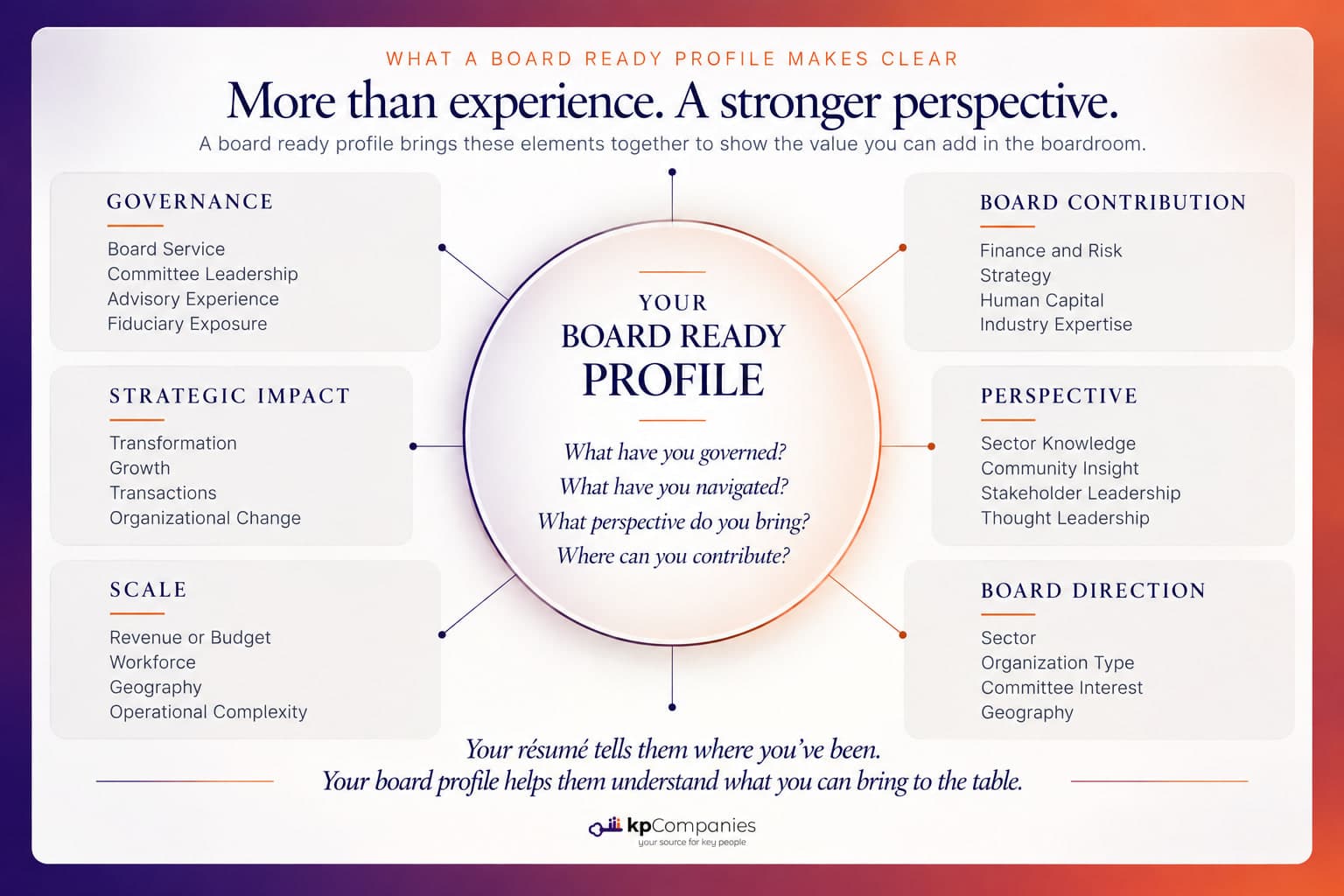
Lead With Governance, Not Job History
A board-specific résumé opens where a traditional one ends. Governance moves to the top of the page, and the career underneath it becomes evidence rather than the headline.
- Governance experience first. Boards, committees, advisory groups — and what you contributed to oversight, strategy, and risk, not simply that you held the seat.
- Strategic impact. The growth you drove, the transformation you led, the complexity you steered an organization through.
- Numbers where you have them. Scale is context, and a committee reads figures faster than adjectives.
- Thought leadership. Writing, speaking, and recognition all signal that you can add perspective in a room of peers.
- One résumé per board. Weight it toward that board's sector and the questions that board is living with right now.
- Presentation. Concise, organized, clean. The document is itself a sample of how you communicate under constraint.
Write the Bio, Too
Committees circulate bios. Expect to be asked for one, and expect it to travel further than your résumé does. Keep it to a page, write it in the third person, and open with the value you would bring to a board table rather than your current title. Then the arc of the career, the board and committee service, the credential that matters, and where you are based. Keep a one-paragraph version ready as well, because that is the length most introductions are made in.
Treat LinkedIn as the Search Surface
Search firms use LinkedIn to identify and qualify candidates, and most board conversations begin somewhere other than a public posting. That makes your profile less of a résumé copy and more of a standing answer to the question a recruiter is actually asking: is this person credible in a boardroom?
- A professional headshot.
- A headline that is clear about what you bring, not only what you are called.
- An About section that states your value proposition as a board candidate in plain language.
- Every board and committee role, including unpaid and nonprofit ones.
- Visible thought leadership and governance contribution, so the claim is demonstrated rather than asserted.
Then balance what you publish. A feed that is all company announcements reads as a communications channel. A mix that includes your own perspective on governance, leadership, and where your industry is heading reads as a director in the making.
Count the Governance Experience You Already Have
Many executives believe they have none, then find a decade of it. Audit or finance committee work. A task force you chaired. An advisory board. A foundation, a professional association, a nonprofit whose growth you helped steward. Presenting to your own board counts as exposure to how boards think, and it belongs in the story.
If there is genuinely nothing yet, nonprofit board service is the most direct on-ramp. Choose a cause you would show up for in a hard year, get close to the work, meet the directors already serving, and learn the governance side deliberately — finances, fiduciary duty, the difference between oversight and management.
Say What Seat You Want
"I'd be open to a board" is not something anyone can act on. Specific is referable. Name the sector you know cold, the type of organization — public, private, or nonprofit, which differ sharply in stakeholders, oversight, and pace — the stage of company where your experience is worth the most, the committee you could contribute to on day one, and the geography you can realistically serve. People cannot recommend you into a seat they cannot picture you in.
The Short Version
- A board résumé that opens with governance and impact instead of duties.
- A one-page bio in the third person, plus a one-paragraph version.
- A LinkedIn profile written for a board audience: headshot, headline, About, every board role.
- The governance experience you already have, named and credited — committee, advisory, and nonprofit work included.
- A clear statement of the seat you are looking for.
- One recent piece of thought leadership you would be glad to be judged by.
If you want a read on where you stand before you rewrite anything, our two-minute Board Readiness Assessment scores your experience against what boards look for and sends you the Ultimate Guide to Board Readiness, which goes deeper on the résumé and LinkedIn work above. And if board service is part of what is next for you, joining the kpCompanies Board Network is how you let us know.

Hey Leader, Don’t Miss What’s Next at kpCompanies!
Something big is coming. From fresh ideas to transformative opportunities, we’re building resources for leaders ready to grow.
Sign up now to be the first to know when it drops and join a community of leaders shaping the future of work.