


Ask a nominating committee what it wants and you'll hear “a strong leader with relevant experience.” That's the job description, not the decision. Here's what actually decides a board seat.
Ask a nominating committee what it is looking for and you will usually hear some version of the same sentence: a strong leader with relevant experience and good judgment. Every candidate on the list clears that bar. It is the job description, not the decision.
What actually decides a board seat is narrower, more specific, and rarely written down. After more than two decades of running searches for board tables, here is what we watch boards weigh.
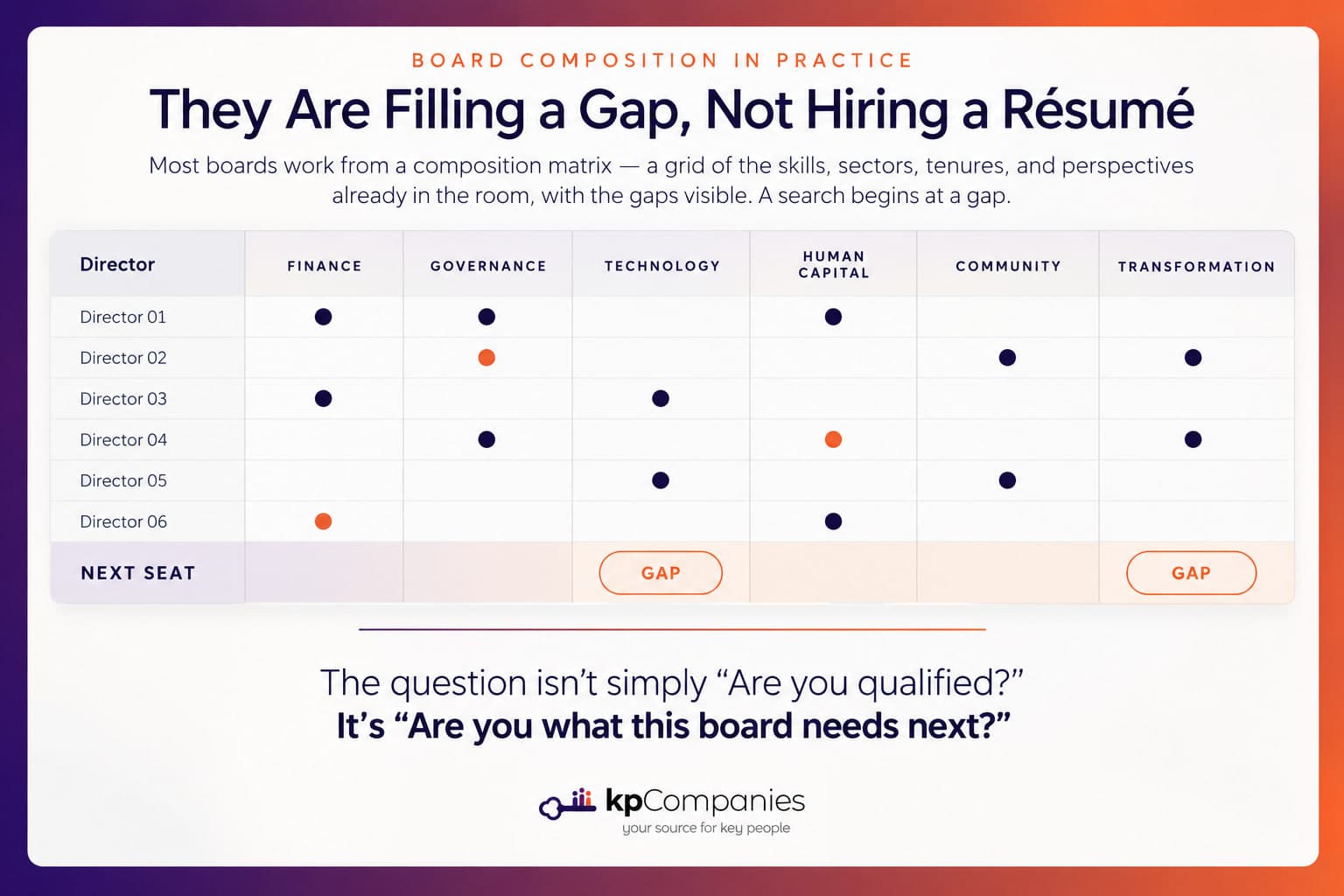
They Are Filling a Gap, Not Hiring a Résumé
Most boards work from a composition matrix — a grid of the skills, sectors, tenures, and perspectives already in the room, with the holes visible. A search begins at a hole. The board that just took on debt is looking for financial depth. The one facing a systems overhaul wants someone who has lived through a transformation. The one whose longest-serving directors are aging out is thinking about succession as much as skill.
This is why strong candidates get passed over and it has nothing to do with quality. You are not competing against every accomplished executive. You are competing against the shape of the gap. The practical move is to stop guessing: ask what the board is missing, and answer that question rather than the one your résumé answers by default.
Judgment Is the Product
An operator is paid for decisions. A director is paid for the quality of the questions that precede them. The shift from running an organization to overseeing one is the biggest adjustment most new directors describe, and boards screen for evidence that a candidate has already made it.
That evidence is specific. A time your analysis changed a decision. A question you asked that was uncomfortable and correct. Feedback you gave a chief executive that landed well enough to be used. Candidates who can tell those stories concretely, without making themselves the hero of every one, read as directors. Candidates who recite scope and headcount read as operators who have not made the turn yet.
Five Kinds of Board Intelligence
Board-relevant experience sorts into five buckets. Strong candidates are not equally strong in all five, but they know which ones they bring and can say so without hedging.
- Financial. You understand the financial condition of an organization well enough to oversee it, challenge assumptions, recognize risk, and ask what the numbers imply rather than simply accepting what is presented.
- Governance. You understand the line between oversight and management. You can think in terms of fiduciary duty, risk, accountability, executive succession, and the long term interests of the organization without stepping into the CEO’s seat.
- Relational. You can work across power lines, build trust, challenge constructively, and help a difficult conversation remain productive.
- Contribution. You know the specific contribution you make at a board table and make it without needing to comment on everything or dominate the room.
- Cultural. You can understand perspectives, communities, functions, sectors, and lived realities different from your own and recognize when the assumptions in the room may be incomplete.
The Expertise Boards Are Adding Now
Boards recruit for the next five years, not the last five. The questions arriving at board tables have changed, and composition is changing behind them.
- Digital technology, and increasingly artificial intelligence — what it can do for the organization, and what it exposes.
- Cybersecurity and enterprise risk, as a standing oversight duty rather than an IT briefing.
- Crisis management, from someone who has actually been through one.
- Organizational and digital transformation, including what it costs an organization to change.
- Sustainable and ethical governance, and the reporting expectations that come with it.
- Global markets and supply chains, for organizations whose exposure no longer stops at the border.
- Human capital — talent, culture, and executive succession as board-level questions.
- Investor, donor, and public relations, depending on who the organization answers to.
If one of these is genuinely yours, lead with it. A board recruiting for a gap you happen to fill will move faster than one weighing a generalist against five other generalists.
Perspective Counts as a Qualification
Boards have widened the range of experience they recruit — age, background, sector, path — and the reason is practical. A board whose members share the same assumptions will miss the same things, and blind spots are expensive at the governance level. What counts is the perspective you can articulate: the markets, communities, or operating realities you understand from the inside that the current table does not.

The Quiet Disqualifiers
Candidates rarely lose a seat on expertise. They lose it on the things nobody lists in the specification.
- Time. Two to three hundred hours a year is a common estimate once preparation, meetings, committee work, and the unplanned issues are counted. Boards can tell when the calendar will not hold it.
- Conflicts. Business relationships, competing board seats, and family ties get examined. Disclose early; discovered later, a small conflict looks like a judgment problem.
- Communication. Expressing a position clearly, listening actually rather than waiting, disagreeing without damage, and making a complex issue plain to stakeholders who are not in the details.
- Integrity, on the record. Boards carry accountability for an organization's conduct, so reputational diligence is real and it is thorough.
Test Yourself Against It
Before your next conversation, answer these the way you would to a committee, out loud, in under a minute each.
- What gap on this board am I the answer to?
- Where has my judgment changed an outcome I did not control?
- Which of the five intelligences do I bring, and which am I still building?
- What can I say about governance — fiduciary duty, risk, succession — from experience rather than reading?
- What is the perspective at this table that is missing without me?
- Can I give this board the hours it actually needs next year?
Our two-minute Board Readiness Assessment scores your experience against these criteria and sends you the Ultimate Guide to Board Readiness, which goes deeper on each one. And if board service is part of what is next for you, joining the kpCompanies Board Network is how you let us know.

Hey Leader, Don’t Miss What’s Next at kpCompanies!
Something big is coming. From fresh ideas to transformative opportunities, we’re building resources for leaders ready to grow.
Sign up now to be the first to know when it drops and join a community of leaders shaping the future of work.